
July 21, 2026. Presentation at 2026 American Society for Human Genetics meeting

Dr. Peter Rogan will be presenting a poster at the 2026 ASHG conference in Montreal (Thursday, October 22, 2026. Poster session- begins 4:15 PM):

Revision of a legacy mutation database for submission of evidence based, functional variants to the ClinVar database at the National Center for Biotechnology Information, NIH

Peter K Rogan & Ben C. Shirley. University of Western Ontario & CytoGnomix

Interpreting the large number of variants identified by whole genome sequencing is challenging due to the number of insufficiently annotated and novel variants in sequenced human genomes. NCBI has released guidelines for submission of evidence-based, functional variants to the ClinVar repository. We describe conversion of a peer-reviewed repository of validated mRNA splicing mutations (F1000Res. 7 [2019]: 1908) to conform to ClinVar requirements. The published set of 341,486 variants was reduced during preparation of compliant gene variant entries, culling 18.5% of the original variant set. The loss of variants resulted from: 1) recent pseudogene redesignations and MANE reclassifications of gene and mRNA accessions, 2) inconsistencies between standard HGVS genome and cDNA variant designations, and 3) elimination of common variants producing allele-specific alternative splicing. Also, the automated preprocessing procedure used by ClinVar also imposes reserved terminology and strict algorithms for interpreting functional variant consequences that were, in some instances, inconsistent with original classifications or expert panel guidelines. Nevertheless, the additional functional evidence of molecular phenotypes frequently resolves classification ambiguities based on discordant prior entries of the same variants, and provides evidence for previously unreported alleles essential for classification. Application of the published ACMG/AMP criterion for functional evidence (PS3) can alter interpretation of variant pathogenicity. We present examples (link to ClinVar variants) of how this both reinforced previous interpretations but also revealed inconsistencies that present new challenges for whole genome analysis.
Pan-Cancer Splicing Web Beacon to be Presented at ACMG Meeting

We’re giving a demonstration and a poster presentation of our new GA4GH-compliant web-based Beacon (https://validsplicemut.cytognomix.com) at the 2019 American College of Medical Genetics and Genomics annual conference this week.
Here are the details:

Pan-Cancer Repository of Validated Natural and Cryptic mRNA Splicing MutationsCategory: “Laboratory genetics and genomics”, Abstract Poster Number:  754 (link to abstract)

Where: Exhibit hall,  Washington Convention Center, ACMG Clinical Genetics Meeting in Seattle, Washington

When: April 2 – 6, 2019; Poster presentation time:  Friday, 4/5 from 10:30am-12:00pm

An e-poster is available on the CytoGnomix website (direct link to poster). The work has been published in F1000Research (link).

If you’d like to meet with Dr. Rogan, please contact him at info@cytognomix.com

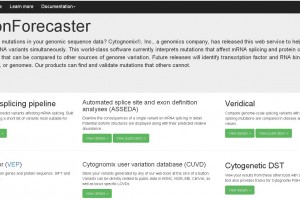
This Beacon resource was created using the MutationForecaster system.

Resources

Links to the latest CytoGnomix products:

Applications and consulting in Geostatistical Epidemiology

Monitoring and discriminating infectious disease hotspots from high disease burden regions, eg. for COVID-19:

Zenodo repository:  Geostatistical Analysis of SARS-CoV-2 Positive Cases in the United States

Defence Canada IDEaS project: Locating emerging COVID19 hotspots in Ontario after community transmission by time-correlated, geospatial analysis 

Addressing large scale radiation incidents and accidents: 

Article in PLOS One: Meeting radiation dosimetry capacity requirements of population-scale exposures …. (Funded by High performance computing consortium: SOSCIP and CytoGnomix)

How to: Protocol for Geostatistical Determination of Radiation Dosimetry Maps of Population-Scale Exposures 

Large scale Radiation Biodosimetry

Capacity of supercomputer version of Automated Dicentric Chromosome Identifier and Dose Estimator  (ADCI) software: Automated Cytogenetic Biodosimetry at Population-Scale and Radiation, Radiation, 2021 (link to published article).

Scalable, democratized access to ADCI:

Overview of Cloud version- ADCI_Online

Presentation to the International Atomic Energy Agency (CRP E35010)

Gene Expression Signatures for Radiation Biodosimetry

Mucaki, E.J., Shirley, B.C. and Rogan, P.K., 2021. Improved radiation expression profiling in blood by sequential application of sensitive and specific gene signatures. International Journal of Radiation Biology,   doi.org/10.1080/09553002.2021.1998709    Link to pdf: Improved radiation expression profiling…

Zhao, J.Z., Mucaki, E.J. and Rogan, P.K., 2018. Predicting ionizing radiation exposure using biochemically-inspired genomic machine learning. F1000Research7(233), p.233.   Link to open access article: https://f1000research.com/articles/7-233

Large Scale Repository of Cancer Splicing Mutations

Pan-cancer repository of validated natural and cryptic mRNA splicing mutations   (a major public resource of mRNA splicing mutations validated according to multiple lines of evidence of abnormal gene expression. )

Article in F1000Research: Pan-Cancer repository of …..

Presentation at the 2019 American College of Medical Genetics Annual Meeting:

Pan-cancer repository of validated natural and cryptic mRNA.ePoster

Interactive Website: Gene signatures for chemotherapy drug response

Demo (Windows): Automated Dicentric Chromosome Identifier and Dose Estimator  

Review on information theory-based splicing mutation analysis:

Caminsky et al. 2014, Videos describing this paper: short and long versions.

Continue reading