Dr. Peter Rogan will be presenting a poster at the 2026 ASHG conference in Montreal (Thursday, October 22, 2026. Poster session- begins 4:15 PM):
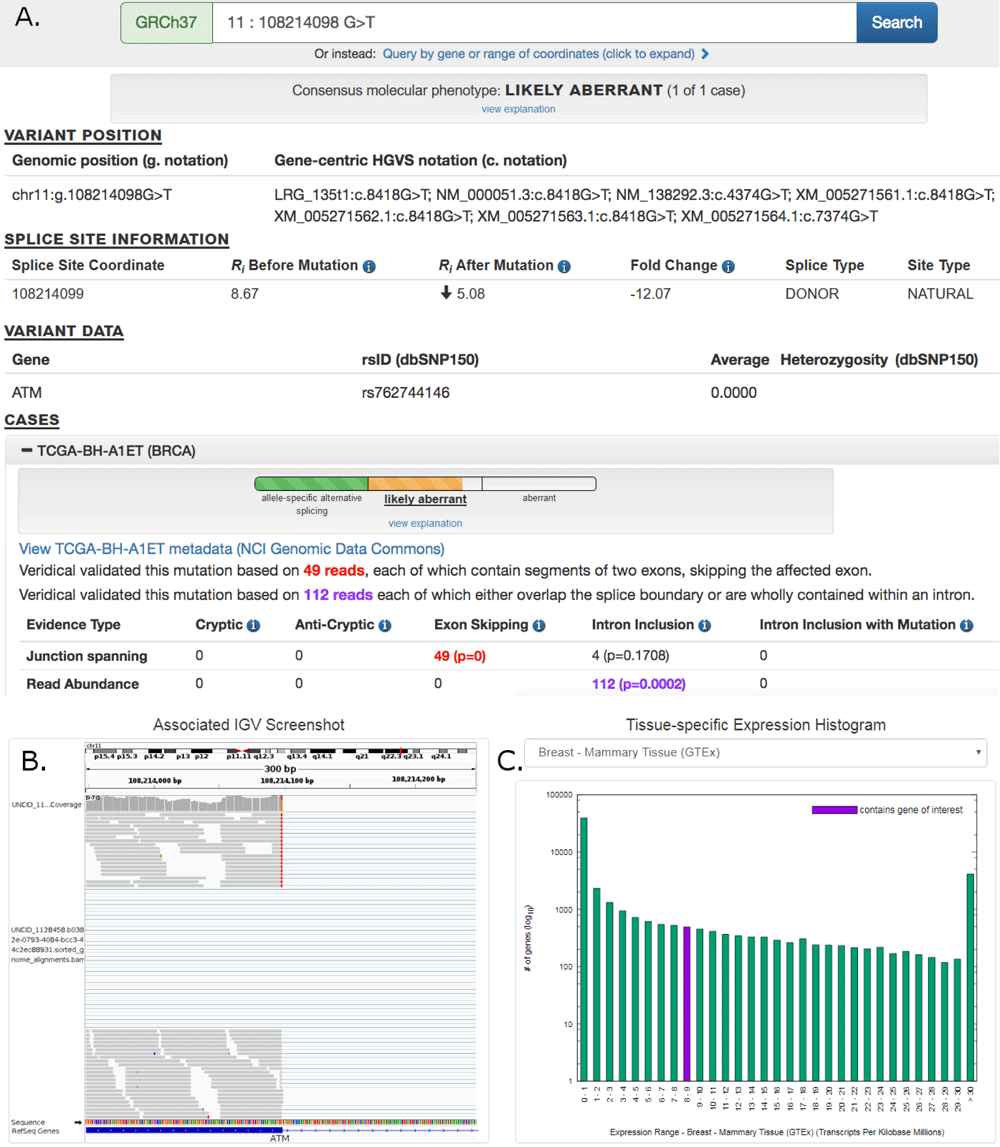
Revision of a legacy mutation database for submission of evidence based, functional variants to the ClinVar database at the National Center for Biotechnology Information, NIH
Peter K Rogan & Ben C. Shirley. University of Western Ontario & CytoGnomix
Interpreting the large number of variants identified by whole genome sequencing is challenging due to the number of insufficiently annotated and novel variants in sequenced human genomes. NCBI has released guidelines for submission of evidence-based, functional variants to the ClinVar repository. We describe conversion of a peer-reviewed repository of validated mRNA splicing mutations (F1000Res. 7 [2019]: 1908) to conform to ClinVar requirements. The published set of 341,486 variants was reduced during preparation of compliant gene variant entries, culling 18.5% of the original variant set. The loss of variants resulted from: 1) recent pseudogene redesignations and MANE reclassifications of gene and mRNA accessions, 2) inconsistencies between standard HGVS genome and cDNA variant designations, and 3) elimination of common variants producing allele-specific alternative splicing. Also, the automated preprocessing procedure used by ClinVar also imposes reserved terminology and strict algorithms for interpreting functional variant consequences that were, in some instances, inconsistent with original classifications or expert panel guidelines. Nevertheless, the additional functional evidence of molecular phenotypes frequently resolves classification ambiguities based on discordant prior entries of the same variants, and provides evidence for previously unreported alleles essential for classification. Application of the published ACMG/AMP criterion for functional evidence (PS3) can alter interpretation of variant pathogenicity. We present examples (link to ClinVar variants) of how this both reinforced previous interpretations but also revealed inconsistencies that present new challenges for whole genome analysis.